How to Play
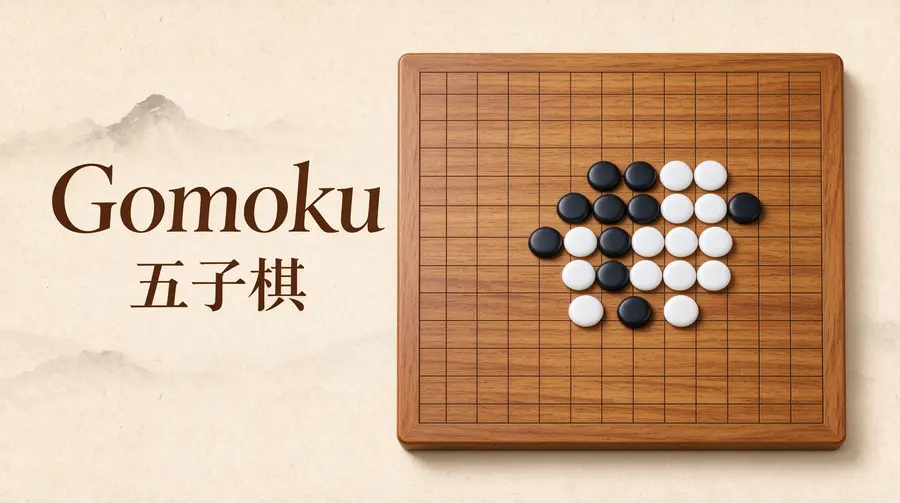
The board: A 19×19 grid of intersecting lines, creating 361 intersection points. Stones are placed on these intersections, not inside the squares. Nine small dots (called “stars”) are marked on the board; the center one is called tengen. Beginners often use a smaller 9×9 or 13×13 board.
The pieces: Black and white lens-shaped stones. A standard set has 180 of each color.
Players: Two. Black moves first, then players alternate placing one stone per turn. Once placed, a stone cannot be moved to another point (though it can be captured and removed).
The goal: Surround more territory (empty intersections enclosed by your stones) than your opponent. At the end, territory plus captured stones determines the winner.
Liberties (“qi”): Every stone or connected group needs liberties — empty adjacent points directly up, down, left, or right (diagonals don’t count). A stone in the center has 4 liberties; on the edge, 3; in the corner, 2.
Capture: If a stone or group loses all its liberties, it is captured and removed from the board. Placing a stone that leaves an opponent’s group with no liberties immediately removes that group.
Key rules:
- Suicide is forbidden: You cannot place a stone that would leave your own group with zero liberties, unless that move also captures opponent stones.
- Ko rule: You cannot immediately recapture in a position that would recreate the exact previous board state. You must play elsewhere first (a “ko threat”) before recapturing.
- Passing: A player may pass instead of placing a stone. Two consecutive passes end the game.
Ending and scoring: The game ends when both players pass consecutively. Dead stones are removed. Under Chinese rules, score = your living stones on the board + empty territory you surround. Black compensates for moving first by giving White 3.75 points (komi), so Black needs 185 points on the board to win.
Basic strategy:
- Corners first, then sides, then center. Fewer stones are needed to enclose territory in a corner than on the side, and fewer on the side than in the center.
- Keep stones connected. Diagonal stones are not connected and can be cut apart. Connected groups share liberties and are harder to capture.
- Make two eyes to live. A group with two separate internal “eyes” (empty points fully surrounded by its own stones) can never be captured, because the opponent cannot fill both without suicide.
- Don’t overextend. Scattered, isolated stones have few liberties and are easy prey.
History and Origins
Go originated in China, with a traditional dating of roughly 4,000 years ago, though the earliest reliably documented references appear in the Spring and Autumn period (around the 6th century BCE). The game was originally called “yi” (弈).
The most famous origin account credits the mythological Emperor Yao with inventing Go to educate and discipline his unruly son, Danzhu. Other versions name Emperor Shun. These are legends, not documented history.
Early written evidence: Go appears in the Analects of Confucius and in Mencius, which mentions a famous Go master named Qiu. The Zuo Zhuan (c. 4th century BCE) contains a reference to a politician “hesitating over a move like a Go player,” showing the game was already a common cultural reference by that time.
Board evolution: Early boards were smaller. A 17×17 stone board from a Han dynasty tomb (2nd century CE) was excavated in Hebei, and 15-line and 13-line boards have also been found. The 19×19 standard appears in a Southern and Northern Dynasties text (around the 5th–6th century CE), describing 361 points as mirroring the days of the year — the same board used today.
Spread beyond China: Go reached the Korean peninsula and Japan via cultural exchange, likely by the 6th–7th century CE. Japan adopted the game enthusiastically; by the Edo period (1603–1868), professional Go houses such as Honinbo were established under shogunate patronage, and a formal ranking system developed that influenced modern professional Go. The game remained largely unknown in the West until the late 19th and 20th centuries.
Modern status: Go is now played worldwide, with major professional systems in China, Japan, and Korea. It became an Asian Games medal event in 2010. AlphaGo’s 2016 victory over Lee Sedol brought unprecedented global attention to the game.